A Practical Guide to Common Fiber Optic Connectors
Fiber optic connectors play a critical role in the performance and reliability of modern fiber networks. While fiber optic cable selection often receives significant attention, connector type, design, and application can directly impact signal integrity, network density, and long-term scalability.
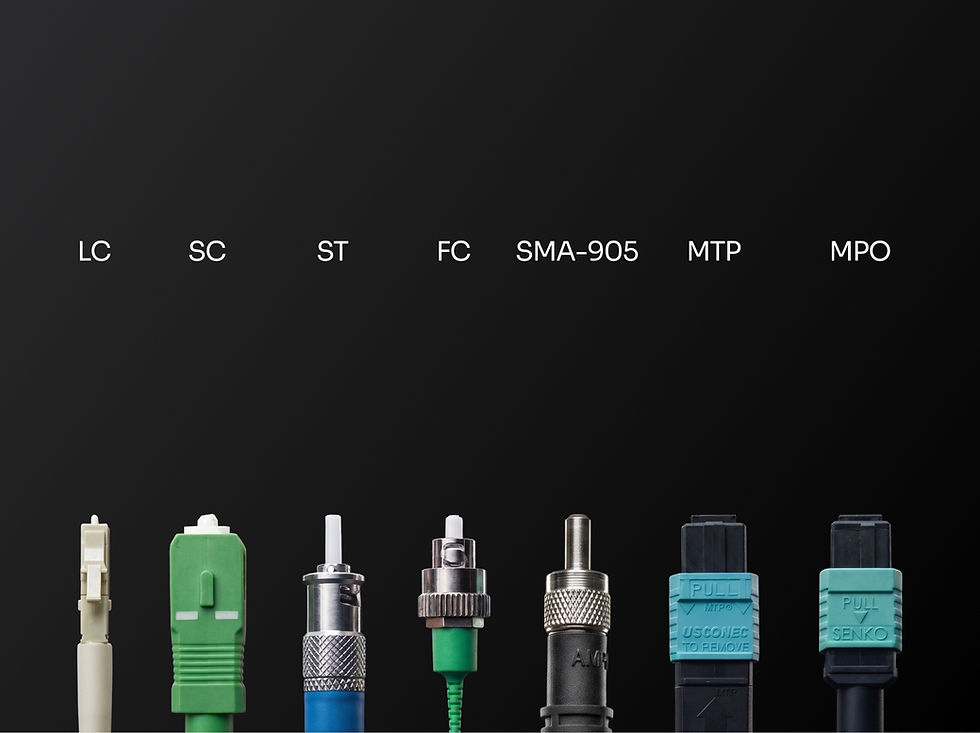
Fiber optic connectors are devices that align and join optical fibers to allow light signals to pass with minimal loss. The most common fiber optic connector types include LC, SC, FC, ST, SMA-905 and MPO/MTP connectors.
In this guide, Neptec OS Inc. explains the most widely used fiber connector types, their applications, and how to choose the right one for your infrastructure.
Why Fiber Optics Connectors Matter
Fiber optic connectors are designed to precisely align optical fibers, allowing light signals to pass between cables, patch panels, and equipment with minimal loss. Poor connector selection, improper handling, or contamination can result in increased insertion loss, back reflection, or intermittent connectivity issues.
Selecting the appropriate connector helps ensure:
Reliable signal transmission
Efficient use of rack and panel space
Easier installation and maintenance
Compatibility with existing equipment
Long‑term network performance
The most widely used connectors today include LC, SC, FC, ST, SMA-905 for a single fiber and MTP/MPO for multiple fibers.
The Most Common Fiber Optic Connectors Explained

LC Connector (Lucent Connector)
The LC connector is the most widely used fiber optic connector in modern networks, particularly in high-density environments like data centers because of its easy-to-use and small form factor
Best for: High-density networks and data centers
Features:
1.25 mm ferrule
Push-pull latch for easy insertion and removal
Compact form factor for dense patching
Available in both single-mode and multimode
Why choose LC?
If space, efficiency, and scalability matter, LCs are often the best choice.

SC Connector (Subscriber/Standard Connector)
The SC connector is a long-standing industry standard known for its simplicity and reliability.
Best for: Telecom rooms, enterprise networks, PON systems
Features:
2.5 mm ferrule
Durable and easy to install
Rectangular shape helps prevent misalignment.
Why choose SC?
SC connectors are dependable, cost-effective, and widely supported across many systems.

FC Connector (Ferrule Connector)
The FC connector uses a threaded coupling mechanism that provides excellent stability and precise alignment.
Best for: High-vibration environments, test equipment, labs
Features:
2.5 mm ferrule
Screw-on design
High resistance to vibration
Why choose FC?
FC connectors are preferred in applications where movement or vibration could affect signal quality.

ST Connector (Straight Tip Connector)
The ST connector is one of the earliest fiber connector types and uses a bayonet-style twist-lock mechanism.
Best for: Legacy systems, industrial automation, and campus networks
Features:
2.5 mm ferrule
Twist-and-lock design
Often found in older or rugged environments
Why choose ST?
ST connectors remain useful in legacy systems and environments where vibration resistance is needed.
SMA-905 Connector
A threaded fiber optic connector standard used for large core multimode fibers, known for rugged construction and high power handling.
Best for: Laser delivery systems, medical and industrial equipment, spectroscopy, fiber optic sensors
Features:
~3.17 mm ferrule
Threaded (screw-on) coupling resists vibration and accidental disconnection
Typically available in stainless steel or other material variants
High-power version may use air-gap or damage-resistant designs
Why choose SMA-905?
SMA-905 connectors are tough, high-power capable, and ideal for harsh or industrial environments where a secure, threaded connection matters more than data-network density.

MTP/MPO Connector (Multi-Fiber Push-On)
MPO and MTP connectors combine multiple fibers—typically 8, 12, or 24—into a single connector to support high-speed data transmission.
Best for: Data centers, parallel optics, high-bandwidth applications
Features:
Multi‑fiber connectivity in a single interface
Supports high data rates (e.g., 40G, 100G, 400G)
Precise polarity and alignment requirements
Why choose MPO/MTP?
These connectors enable high-density, high-speed network architectures but require careful design and quality components.
Single‑Mode vs. Multimode Connectors
Connectors may look identical from the outside, but they are designed for different fiber types:
Single‑mode (SM): Long-distance transmission, higher precision, low signal loss
Multimode (MM): Shorter distances, cost-effective solutions
Insertion Loss and Return Loss: What to Know
Two technical terms come up often when discussing connectors:
Insertion loss: Signal loss as light passes through the connection
Return loss: Light reflected back toward the source
High-quality connectors minimize both. Poor polishing, contamination, or improper mating can quickly degrade performance.
Connectors should be cleaned before every mating to prevent contamination-related signal loss.
How Neptec OS Inc. Supports Smarter Fiber Connections
At Neptec OS Inc., we design and support fiber optic solutions with real-world performance in mind. Our approach blends technical expertise with practical deployment knowledge, helping customers:
Select the right fiber and connector types for their application
Reduce signal loss/reflection and installation errors
Build networks that scale with future demands
Whether you’re upgrading an existing system or designing a new fiber network from the ground up, having the right guidance makes all the difference.
Frequently Asked Questions (FAQ)
What is the most commonly used fiber optic connector today?
LC connectors are currently the most popular due to their small size and compatibility with high‑density equipment.
Can different fiber connectors be mixed?
Connectors prefer to be mated with the same type. Hybrid adapters can be used for different types, but improper combinations could cause high loss.
How often should fiber connectors be cleaned?
Every time before mating. Even new connectors can contain microscopic debris.
Are MPO and MTP connectors the same?
MTP and MPO are both high-density, multi-fiber connectors. MPO is the generic industry standard. MTP (Multifiber Termination Push-on) is a registered trademark brand of MPO connector manufactured by US Conec. While physically compatible, MTP connectors feature enhanced engineering for superior durability and optical performance.